DDQ automation
A due diligence questionnaire, answered from the fund documents you already file
This page is the workflow rather than the pitch: what happens to an ILPA template or an allocator’s own ODD questionnaire between it landing and the response going back, who signs it off, and which document each answer was drawn from.
What happens between the DDQ landing and the response going back
Five steps. Compliance only really works in the fourth one, and the fifth is the one that stops two answers disagreeing in front of an allocator.
- 01
Upload the DDQ, in any format
An ILPA template, a bespoke ODD questionnaire, an allocator's own spreadsheet. XLSX, DOCX, PDF. Tribble parses the question and answer structure automatically, regardless of format.
- 02
Drafting from approved fund content
Each question is matched to your approved sources: fund documents, compliance policies, offering memoranda, prior DDQ responses and regulatory filings. Nobody retrieves a document they could not already open.
- 03
A draft with the source attached
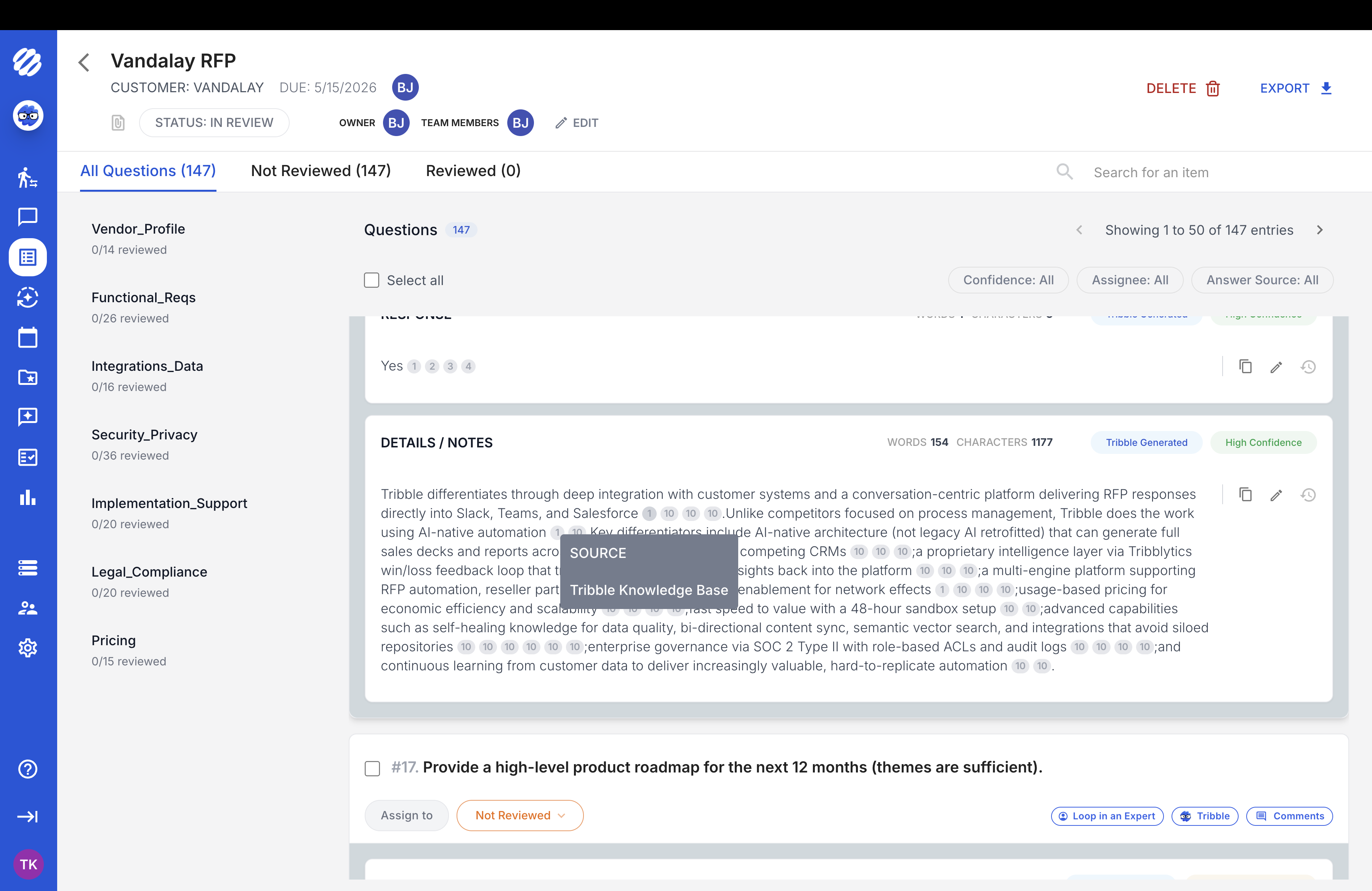
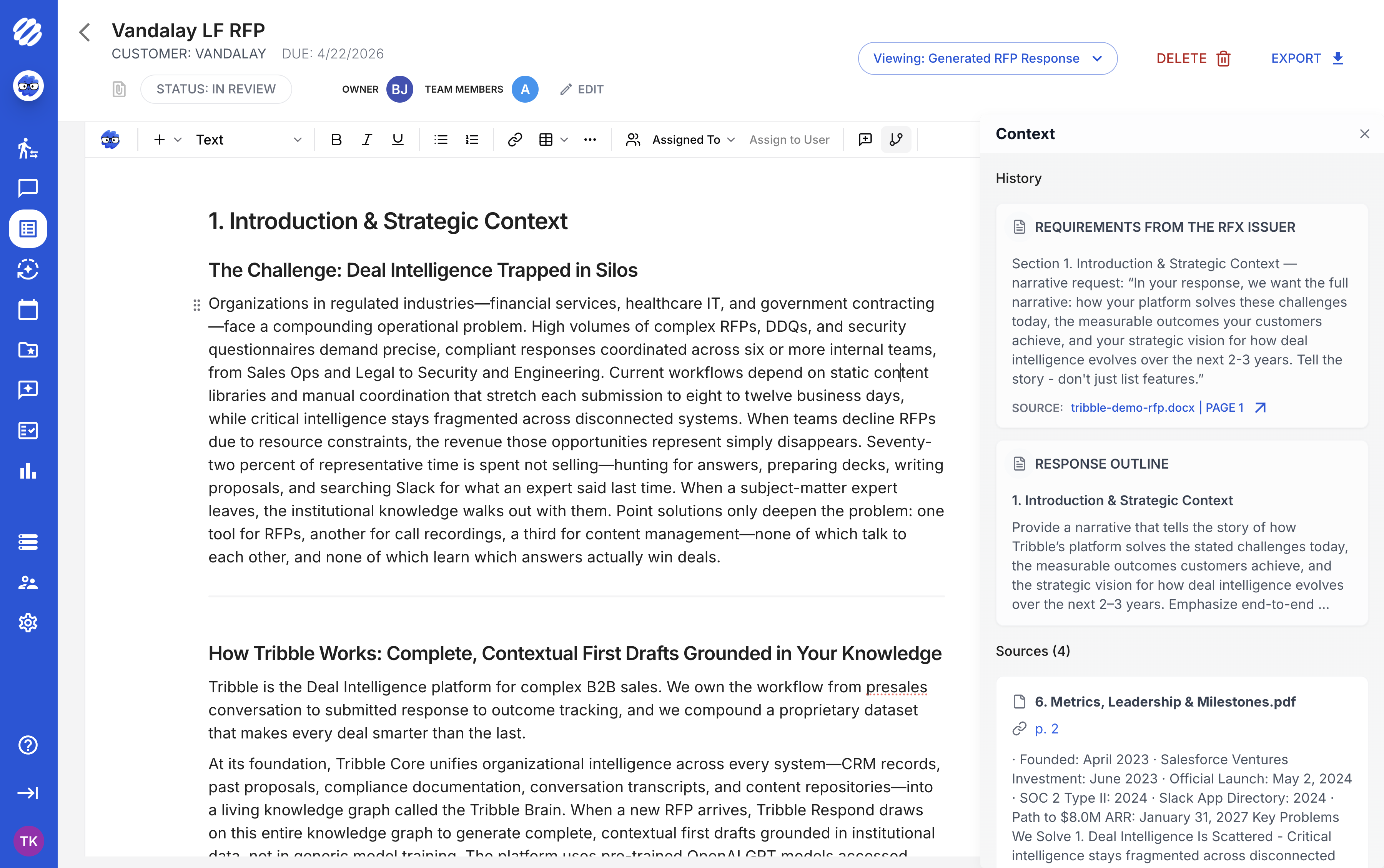
Every answer carries a confidence score and a direct link to the source document it was drafted from. The answer is shaped by the investor relationship, from LP priorities to what you told them last time.
- 04
Review by the person who owns the answer
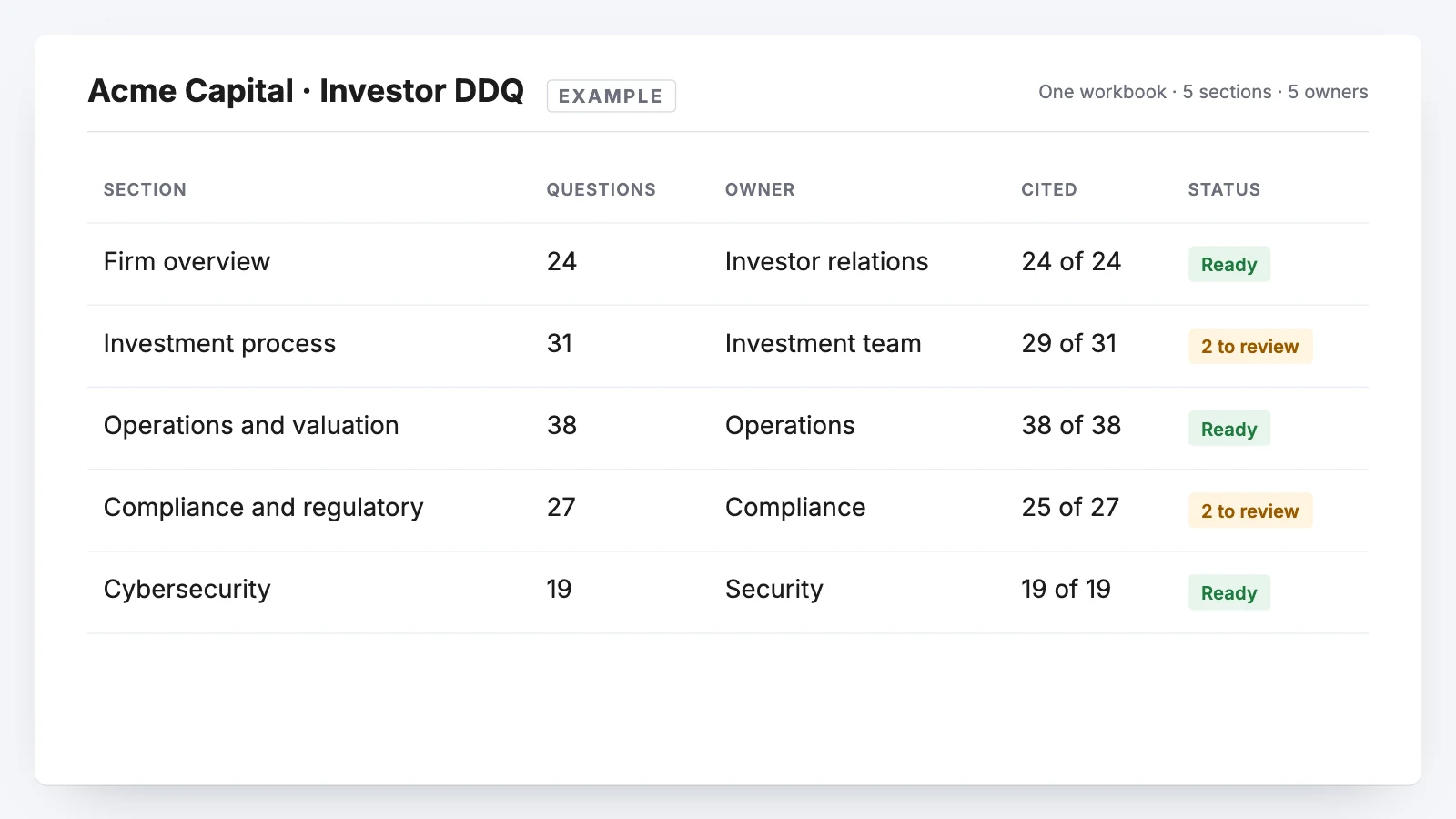
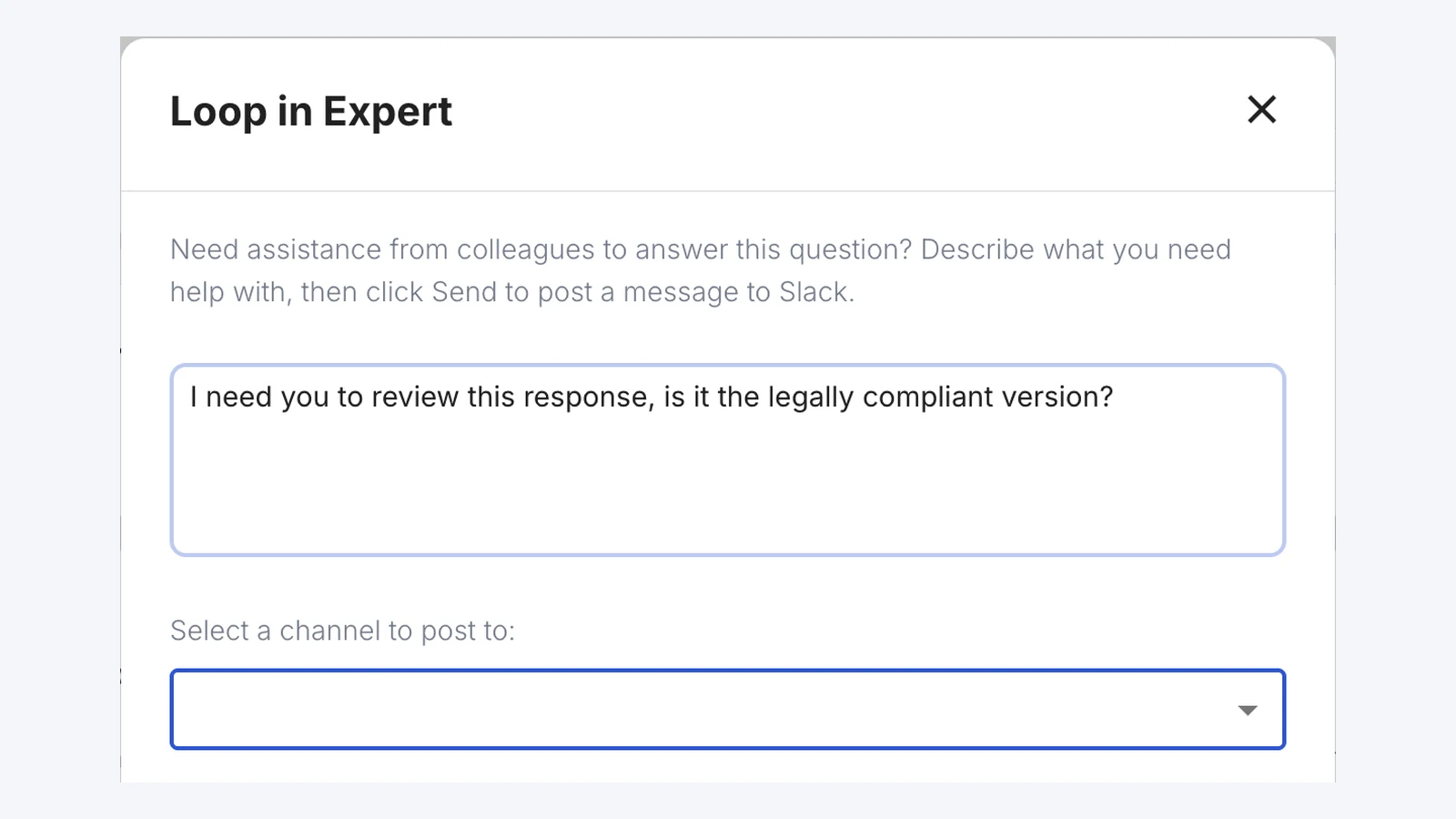
Low-confidence answers route to the right reviewer: compliance questions to the CCO, operational questions to the COO, investment questions to portfolio managers. They verify a citation rather than read unattributed output.
- 05
Consistency check, then submit
A consistency checker flags contradictions across every answer before review. Export in the investor's required format. Approved responses are preserved so the next DDQ reuses reviewed context.
What a sourced DDQ answer gets you that a stored one does not
A DDQ is not an operations task. It is the moment an allocator decides whether your firm is as careful as it says it is.
Shaped by the investor in front of you
Answers are drafted in the context of the full relationship, from LP priorities to what you told this allocator in the last DDQ. A stored answer reflects whichever allocator asked first.
Evidence a CCO can verify
Every answer links to the fund document, ADV language or compliance record it was drawn from. Your CCO signs off on a citation rather than on unattributed AI output.
Review where review is needed
Per-answer confidence scores show which answers need compliance review and which are ready for signoff. The reviewers who are hardest to get read the shortest list.
Nothing contradicts anything else
The consistency checker runs across the full DDQ before submission. Two answers can each be defensible and still disagree, and a diligence team reading both at once is the worst place for that to surface.
Changes since the last submission are flagged
Where an answer has moved since the last DDQ this allocator received, you find out before they do. A quietly changed answer is the one that starts a follow-up round.
Built to be audited
SOC 2 Type II, SSO, RBAC and answer-level audit history. Who approved what, drawn from which document version, on what date.
What it accepts
The structure is parsed out of the file. An allocator who built their own template is the normal case, not the exception.
What an institutional DDQ asks about, and where each area goes wrong
The sections below are common to ILPA templates, bespoke ODD questionnaires and most allocator formats. Each one fails in a specific, repeatable way.
Firm, ownership and governance
"Describe the ownership structure of the management company, key-person provisions, and any changes since our last review."
Drawn from the current operating agreement, the Form ADV and the prior DDQ you sent this allocator. Changes since the last submission are surfaced rather than buried, because an allocator who spots one you did not flag reads it as something other than an oversight.
Where it goes wrong A partner departure disclosed in the ADV but still absent from the DDQ answer, found by a diligence analyst reading both.
Investment process and strategy
"Describe your investment process, the sources of your edge, and how position sizing and portfolio construction decisions are made."
Drafted from the investment memos and strategy documentation the team actually works from, with the source attached. The portfolio manager reviews a citation rather than rewriting a paragraph from scratch under a deadline.
Where it goes wrong A strategy description written for a fundraise two years ago that no longer matches how the book is run.
Operational due diligence
"Detail your trade lifecycle, reconciliation frequency, segregation of duties, and your business continuity and disaster recovery testing."
Answered from the operations manual, the service-provider agreements and the most recent BCP test record. The answer names the document and its date, which is the specific thing ODD teams check and the specific thing a stored answer cannot give them.
Where it goes wrong A reconciliation frequency that was true when the operations manual was written and changed when the administrator changed.
Compliance and regulatory
"Provide your compliance manual, detail your personal trading policy, and disclose any regulatory examinations, findings, or enforcement actions."
Routed to the compliance manual, the code of ethics and the ADV as they are currently written, with the CCO as the named reviewer. This is the section where an unsourced answer is a real risk, not just an inaccuracy.
Where it goes wrong An examination disclosure that is accurate in the ADV and incomplete in the DDQ, because two people maintained two documents.
Valuation and financial reporting
"Describe your valuation policy, the role of the valuation committee, and how level 3 assets are priced and reviewed."
Drafted from the valuation policy and the committee charter, with the pricing hierarchy as documented. Nothing is paraphrased into something cleaner than the policy says, because the policy is what gets produced in the follow-up.
Where it goes wrong A valuation description tidier than the actual policy, which then reads as a discrepancy when the policy is attached.
Fees, expenses and terms
"Detail the management fee, the performance fee and its crystallisation, the hurdle, and every expense borne by the fund."
Matched against the LPA and the current offering memorandum. The answer and the document behind it are the same document, which is the whole point of the section.
Where it goes wrong An expense description drawn from a prior fund’s terms, in a response for the current vehicle.
ESG and responsible investment
"Describe your ESG policy, how it is integrated into the investment process, and your reporting against it."
Drafted from the ESG policy and whatever reporting exists, with the honest extent of integration stated. Where the policy is thinner than the question implies, the answer says so, which is a better outcome than a claim the next report contradicts.
Where it goes wrong An ESG answer written to the question rather than to the policy, which then has to be walked back in annual reporting.
The same answer layer, in response work that gets audited
Tribble has no published asset-manager story yet. These numbers are from teams running this workflow where being wrong carries a real cost.

How this differs from what you are probably using
Three alternatives, described as their users would describe them rather than as a competitor would.
| Tribble Respond | Static answer library | Legacy response platform | ChatGPT or Claude | |
|---|---|---|---|---|
| Where the answer comes from | Retrieved live from governed fund sources | An answer somebody wrote and has to maintain | Stored historical responses | Files or prompts assembled by hand |
| Source attribution | Every answer links to the fund document | A manual reference, if someone added one | A manual reference, if someone added one | No way to verify where it came from |
| Confidence scoring | Scored per answer, before compliance review | None | None | None |
| Consistency check before submission | Contradictions caught across the full DDQ | None | None | None |
| Reviewer routing | Source, confidence, owner and audit context | Whoever you remember to ask | Manual review after draft | Whoever you remember to ask |
| Changes since the last submission | Flagged against what this allocator last received | None | None | None |
| Learns from completed DDQs | Reviewed answers carry into the next one | Only when somebody edits the library | Historical answer reuse | Nothing persists |
| Audit and access control | SOC 2 Type II, SSO, RBAC, answer-level history | Whatever the document store enforces | Platform roles | Whatever was pasted in |
The questions worth answering before you evaluate anything
Not the objections a vendor prepares for. The ones that decide whether this is worth a pilot.
"Our operations team already handles DDQs manually."
Then the question is not speed, it is what your CCO is signing. Here they review a sourced answer with a confidence score and a link to the fund document, rather than a paragraph somebody drafted from memory. The consistency checker catches contradictions across the whole response before an allocator sees them.
"How do I trust the AI’s answers?"
You do not have to. Every answer ships with the source document attached, so the review is verification rather than trust. Where the approved content does not cover a question, it comes back marked as uncovered rather than filled in, which is the behaviour a general-purpose model cannot offer.
"Does it handle our allocators’ formats?"
Spreadsheet, document, PDF and portal-style DDQs, including ILPA templates and bespoke ODD questionnaires. The question structure is extracted, the answer drafted from approved fund knowledge, and the source citation preserved through to export. Expert routing sends uncertain answers to the right reviewer before submission.
"What is the ROI?"
It depends on DDQ volume, hours per response, review depth and how much work moves from drafting to verification. The ROI calculator runs your own numbers. The recovered hours are the smaller half of it; the other half is not losing an allocation to a correction cycle.
One stale DDQ answer can slow an allocation decision. A response that cites the wrong version of a fund document sends investors back into diligence mode and your team into correction cycles, at the exact moment capital is moving. That is the risk the source trail exists to remove.
Where it reads from
The content stays where it is. Permissions come with it.



Questions that come up before a first DDQ
The ones asked on nearly every call.
How do asset managers automate DDQ responses?
Asset managers automate DDQ responses by uploading due diligence questionnaires from institutional investors or allocators into AI that matches each question to approved fund documentation, compliance policies, and prior DDQ responses. Every answer includes a confidence score and links to the source document, so compliance teams verify evidence rather than unattributed output. The system flags changes since the last DDQ submission and improves accuracy with every completed questionnaire. It works for operational due diligence (ODD), investor DDQs, hedge fund compliance questionnaires, and regulatory assessments.
What types of due diligence questionnaires can Tribble automate?
Operational due diligence (ODD) questionnaires, investor DDQs, hedge fund compliance questionnaires, private equity operational assessments, endowment and foundation DDQs, RIA regulatory questionnaires, and custom institutional investor formats. The AI sources answers from your fund documentation, compliance policies, and prior DDQ responses regardless of the questionnaire format or the type of allocator requesting it.
What DDQ formats does Tribble support?
XLSX, DOCX, PDF, ILPA DDQ templates, custom ODD templates, and direct portal integrations. The question and answer structure is parsed automatically, regardless of format. Teams can upload a real DDQ as soon as source access and review ownership are in place.
How does Tribble handle accuracy and compliance?
Every AI-generated answer includes a confidence score and links to the source documents it was drafted from. A consistency checker flags contradictions across answers before human review. Compliance teams review sourced evidence, not unattributed AI output. SOC 2 Type II certification, SSO, RBAC, and answer-level audit history are included.
Can Tribble work alongside our existing compliance tools?
Yes. Tribble works alongside existing document management, compliance monitoring, and company knowledge systems. During evaluation, teams can compare sourced AI-drafted answers against their current DDQ workflow, then expand once source access, review ownership, and export expectations are validated.
What integrations are supported?
Salesforce, HubSpot, SharePoint, Google Drive, Confluence, Notion, Slack, Microsoft Teams, Gong, Clari, DocuSign, Box, OneDrive, and other connected systems. CRM integration is bidirectional. Expert routing works through Slack and Teams.
How long does onboarding take?
Onboarding starts by connecting the source systems and content your team already uses, then mapping review ownership, confidence rules, and export workflows around your current response process. Teams can begin with a focused workflow and expand once the first sources and reviewers are validated.
How does pricing work?
Tribble offers annual platform editions based on response volume, included projects, included Sales Agent users, and enterprise requirements. The pricing page shows the current edition structure, and sales can help map the right starting point for your team.
Read next
The other response workflows this runs on.
RFP automation
A 200-question request answered from the proposals you have already won.
Security questionnaires
SIG, CAIQ, VSA and a buyer’s own spreadsheet, answered from approved evidence.
Long-form responses
Narrative sections, not just question and answer grids.
Financial services
Fund DDQs, investor questionnaires and regulatory filings.
ROI calculator
Run your own volumes rather than ours.
Tribble Respond
The product all five workflows run on.